In a shared-aircraft operation, a flight time is never just a number. It’s the basis for what a member owes. So the moment someone corrects flight time after the fact, and times do get corrected, the money attached to that flight is suddenly wrong too.
This is one of the quiet headaches of running a club, a flight school or a partnership. Flying is the easy part. Keeping the books straight when flights get edited is where things can start to get complicated and frustrating.
Occasionally flight times need to be corrected
Times get entered by people, and people make mistakes or run into situations that change the number after the flight is logged. A few of the usual suspects:
- A Hobbs or tach reading gets typed in wrong: a transposed digit or a missing decimal.
- A lesson ends early and the student was billed for the full slot.
- A student flew with an instructor, but the CFI wasn’t added to the flight.
- A number simply gets fat-fingered at the end of a long day.
We’ve all been there. None of these cases are out of the norm. Over a busy month across a fleet or a shared airplane, a handful of flight corrections are par for the course.
The flight edit is easy. Accounting for the costs is more involved.
Fixing the time itself only takes a few seconds. Fixing everything else downstream is where things usually get messy, because a change to flight time ripples straight into billing.
Two situations, two very different problems:
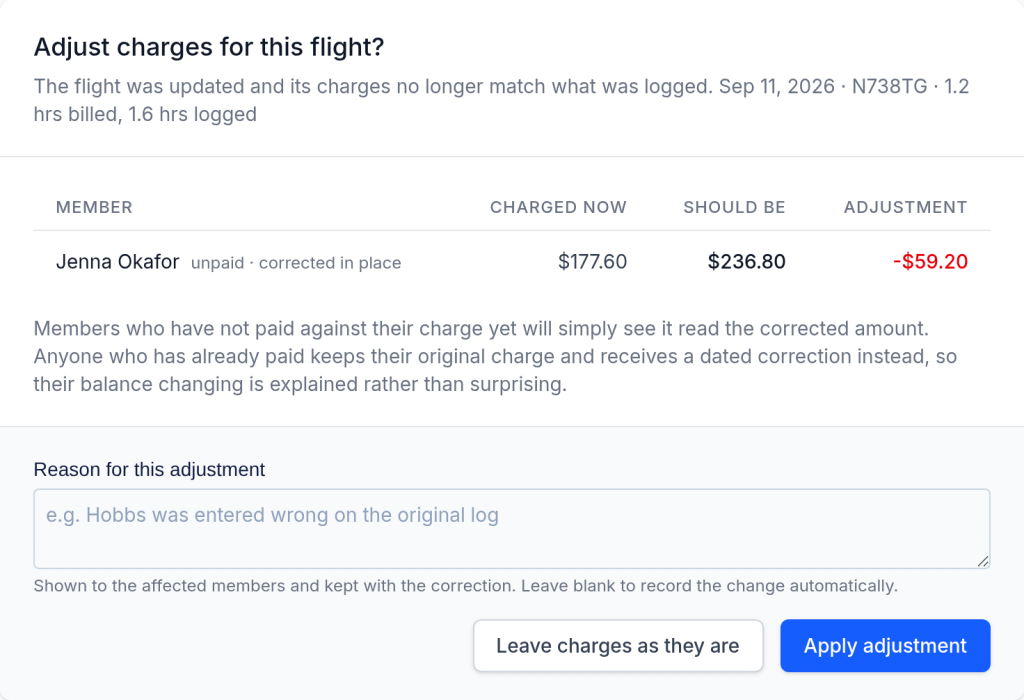
- The flight has not been paid for yet. The fix is straightforward in principle: the charge should update to match the corrected time. Simple, as long as the charge actually follows the correction instead of being left behind.
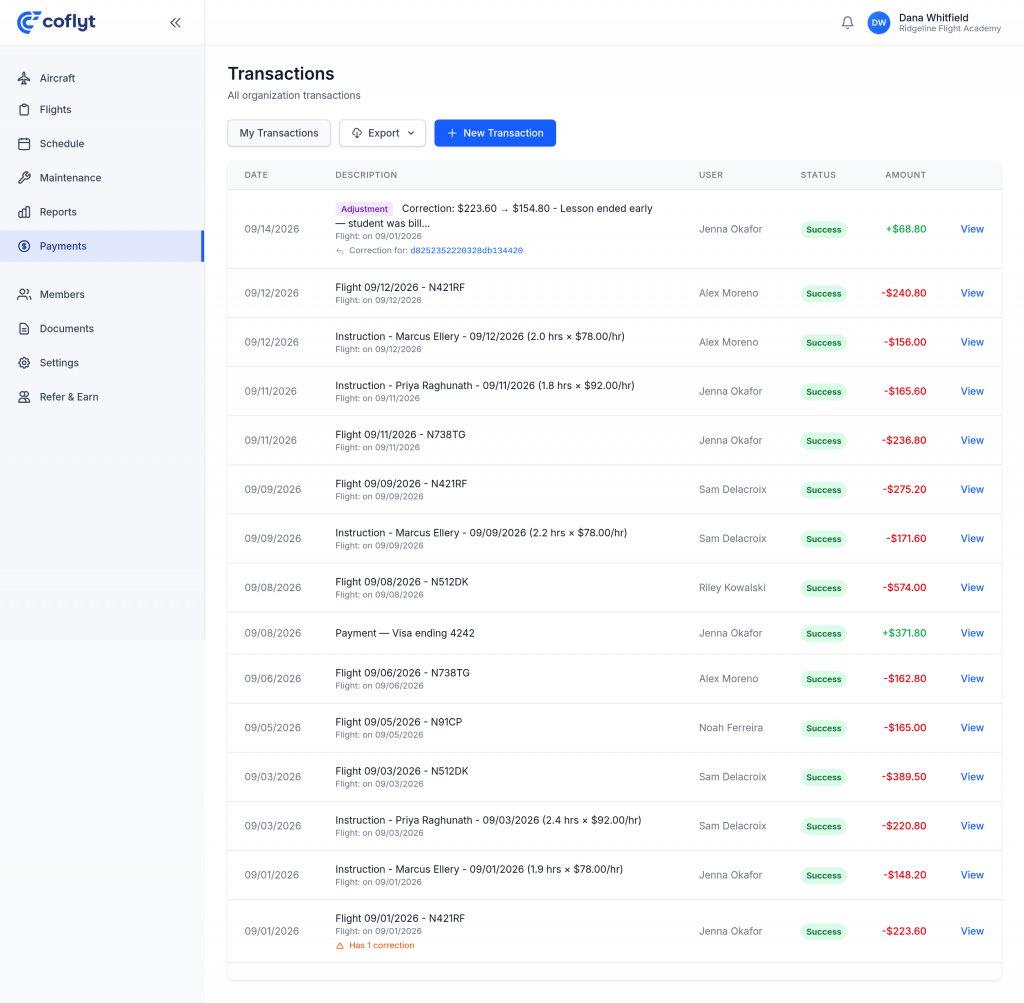
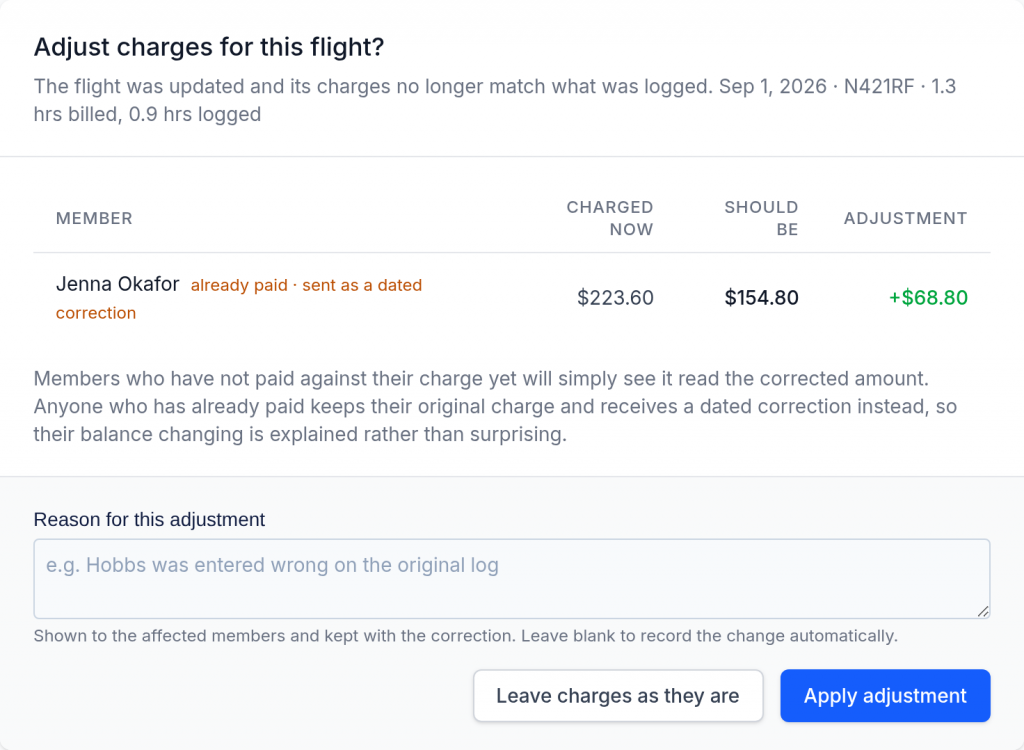
- The flight has already been paid. Overwriting the original charge isn’t an option, and for good reason. Doing that erases the record of what actually happened, and in a shared operation that is exactly the kind of thing that erodes trust (not to mention it’s a “no-no” in accounting best practices). The right move is an adjustment: the original line stays, and a dated correction posts against it so the math comes out right and the history stays intact.
Handled by hand, both of these situations mean extra time, side notes and the occasional awkward message to a member about why their balance changed.
What good correction handling looks like
Whatever system you use, a correction you can trust has the same handful of qualities:
- The billing follows the time automatically. Unpaid charges update automatically; changes to paid charges go to an admin to review and confirm before posting.
- Paid and unpaid are treated differently. Unpaid charges correct in place. Paid charges post a dated adjustment so the original record survives.
- There is a full audit trail. Every correction shows what changed, who made the change and when, with a note on why.
- Admins have visibility. Adjustments are flagged, not buried, so whoever runs the books can see what moved and approve changes to paid charges before they post.
- A human can still override. Automation handles the common, unpaid case, but an admin can always step in and adjust manually, including when reviewing a change to a paid charge.
- Settled charges stay settled. Charges already reconciled in a payout batch are locked, so a correction can’t reopen closed books.
That combination is what separates a clean set of books from a running dispute about who owes what.