

BasicMed Explained (and the Perfect Place to Keep Those Required Forms)
Since BasicMed launched in 2017, more than 90,000 pilots have qualified to fly under the program. It’s one of the biggest wins for general aviation in decades: no AME appointment, no third-class medical and a checkup with the doctor you already see.
But there’s a catch that a lot of pilots miss. Under BasicMed, the FAA doesn’t keep your medical paperwork. You do. And if you can’t produce it when asked, you can’t prove you’re legal to fly.
BasicMed in a nutshell
BasicMed is an alternative to the FAA third-class medical certificate. Instead of visiting an Aviation Medical Examiner, you get a physical from any state-licensed physician and complete a free online medical education course.
To use it, you need a valid U.S. driver’s license and you must have held an FAA medical certificate at some point after July 14, 2006. The FAA Reauthorization Act of 2024 also expanded what you can fly under BasicMed. As of November 2024, BasicMed pilots can operate:
- Aircraft with a maximum takeoff weight up to 12,500 pounds (up from 6,000)
- Aircraft authorized to carry up to seven occupants, with no more than six passengers
- At or below 18,000 feet MSL and 250 knots
- VFR or IFR within the United States, not for compensation or hire
That expansion opened BasicMed to a lot more owners of larger singles and light twins, which is one reason more pilots are making the switch.
Meet FAA Form 8700-2
The heart of BasicMed is FAA Form 8700-2, the Comprehensive Medical Examination Checklist (CMEC). It has three sections:
- Section 1: Instructions for you and your physician
- Section 2: Your part. Personal information, medications, medical history and a signed declaration that your answers are true and complete
- Section 3: Your physician’s part. A head-to-toe exam covering vision, hearing, blood pressure and more, followed by the doctor’s signature confirming they know of no condition that could interfere with safely flying
Here’s the part that surprises people. Nothing gets mailed to the FAA. Item 3 of the form’s instructions says the completed checklist must be kept in your logbook “in any legible paper or electronic format” and made available on request.
The same goes for the certificate you receive after finishing your BasicMed online course. It lives in your logbook too. If the FAA asks, those two documents (plus your pilot certificate and driver’s license) are your proof that you’re flying legally.
Two clocks to track
BasicMed runs on two separate timers, and both must be current every time you fly as pilot in command:
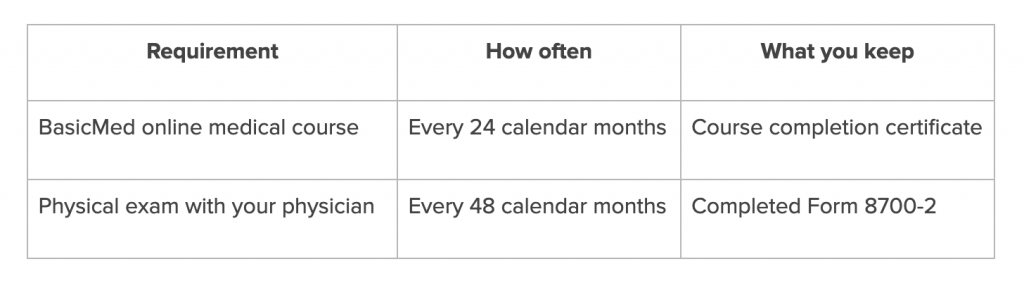
The course is free through AOPA or the Mayo Clinic and your regular doctor can complete the exam. If either requirement lapses, you’re not able to fly under BasicMed until it’s renewed.
One more thing worth knowing: the current version of Form 8700-2 still lists the old six-occupant and 6,000-pound limits. AOPA flagged the error and the FAA has acknowledged it. Go by the FAA’s BasicMed website for current limits, not the form.
Paper gets lost. Coflyt is accessible anywhere.
Loose paper isn’t easy to keep up with. Think about where that checklist usually ends up. Folded into a paper logbook. Stuck in a desk drawer. Saved as a phone photo somewhere between your kids’ soccer pictures and a screenshot of a METAR.
The FAA explicitly allows an electronic copy, which means you don’t need a paper version at all. Coflyt keeps a digital file you can find whenever you need it. You’re already using Coflyt to track your aircraft’s maintenance, documents, insurance and medical certificate, so your BasicMed records can sit right alongside them, organized and accessible from your phone whether you’re at home or on the ramp.
And because BasicMed runs on two different clocks, keeping everything in one place makes it much easier to see when your next course or exam is coming due. No more digging through a drawer to figure out when you last saw your doctor.
Your BasicMed records checklist
Have these when you fly:
- Your pilot certificate
- A valid U.S. driver’s license (and you’re following any restrictions on it)
Keep these handy if the FAA asks:
- Your completed and signed Form 8700-2, all three sections
- Your BasicMed course completion certificate from the last 24 calendar months
- Your physical exam date, within the last 48 calendar months
Upload your checklist and course certificate to Coflyt so they’re always easy to find. Then set up an inspection item for each so Coflyt reminds you before it’s time to renew.